Choose the headroom.
Nickel is the reference profile. Alloy and Steel progressively increase magnetic headroom, giving the same source more room before the core compresses.
03 / TRANSFORMER SATURATION
DRIVEN INPUT / MAGNETIC MEMORY
From quiet density to heavy analog destruction.
An input circuit and magnetic path, driven together.
WINDOWS x64 · VST3 + STANDALONE · v0.3.0
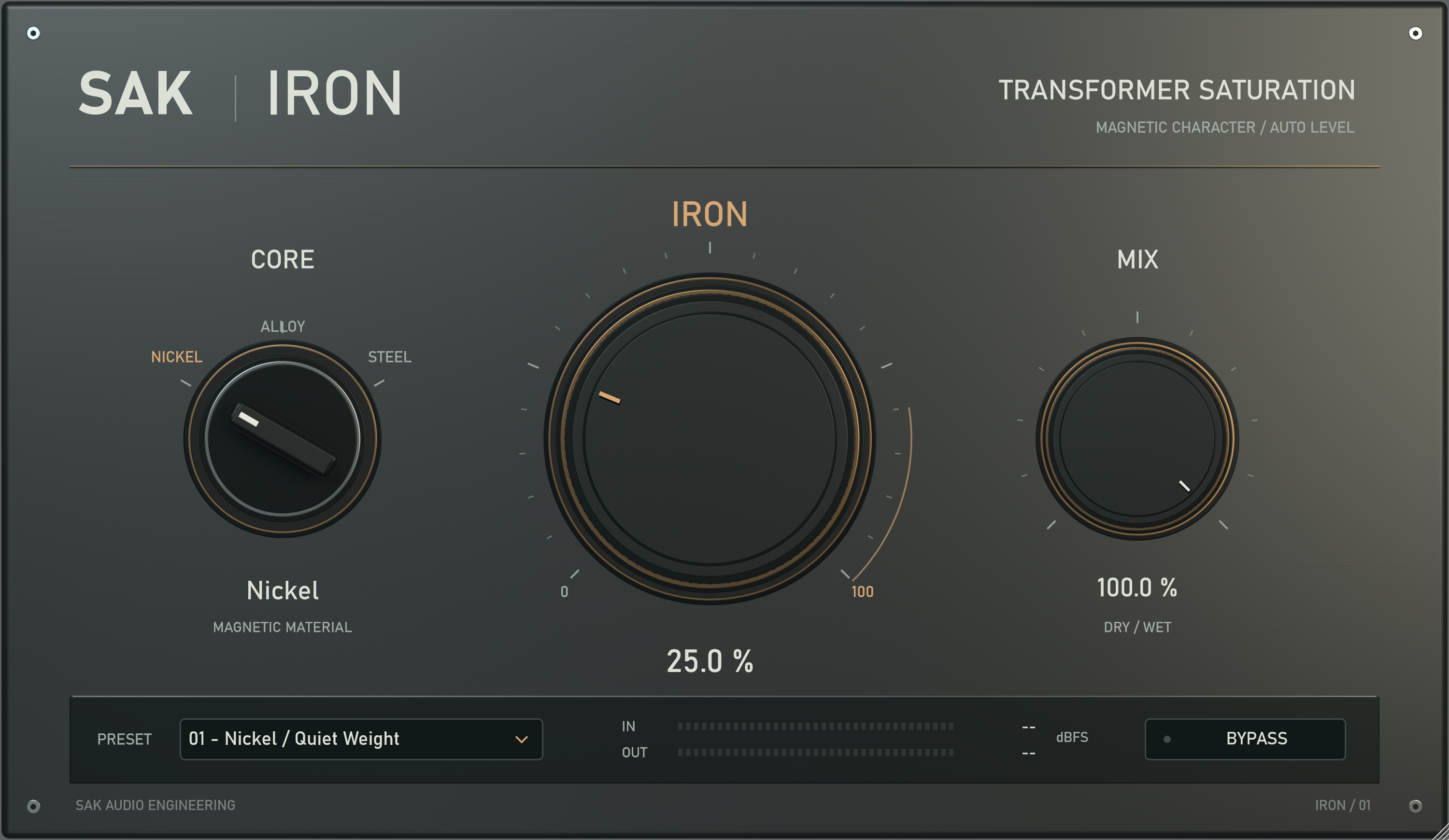
CLEAN BEGINNINGS / HEAVY ENDINGS
Keep IRON low for an essentially clean path. Turn it up for body, compression and increasingly complex harmonics. Push further and the input stage and transformer become part of the performance.
Start with Nickel, IRON at 25% and MIX at 100%. The same setting responds differently to a quiet stem and a loud bus. Listen to the attack as well as the sustain, especially on bass-rich material.
For heavier treatment, bring MIX down to retain some of the original transients. Automatic level compensation follows the controls throughout.
CORE / IRON / MIX
Nickel is the reference profile. Alloy and Steel progressively increase magnetic headroom, giving the same source more room before the core compresses.
Move continuously from clean operation through subtle density and audible saturation to heavy abuse. The final fifth of the range is deliberately excessive.
Blend the processed path with latency-aligned dry audio. Use full wet for the complete circuit response or work in parallel for a stronger original attack.
THE SHORT VERSION
Finite headroom and slightly asymmetric rail conduction shape the signal before it reaches the magnetic stage. As drive rises, the input circuit increasingly compresses peaks and generates harmonics.
A nonlinear flux circuit loads the driven input. Flux and coupling states carry history, making frequency, level and envelope part of the response. Bass reaches magnetic saturation before higher frequencies.
Fixed curves calibrated offline follow CORE and IRON. There is no live gain rider. Transient compression, harmonic balance and frequency-dependent saturation remain audible.
Separate recordings of a heavily driven analog input path, with and without its transformer, informed the redesign. Nine candidate architectures were compared against sine tests and complete program material. The manual records both agreement and remaining differences.
Controls, equations, calibration, measurements, references and the limits of the model.
MEASURED / WITH CONDITIONS ATTACHED
Maximum measured THD at IRON 0%
Internal oversampling at 44.1 / 48 kHz
Fixed reported host latency
THD: supplied 20, 50, 100 and 1000 Hz sine tests, −30 through −3 dBFS, all three CORE profiles. Oversampling adjusts with host rate. Low-drive behavior is essentially clean; extreme drive retains measurable aliasing. The model has flux and capacitor memory, with a reversible magnetic law. See the manual for harmonic and transient mismatches and the measurement conditions.
SAK-IRON / v0.3.0
Free to use. Source and technical manual included.
Windows x64 · mono and stereo VST3.
Optional standalone application.
Driven input and transformer saturation, from a clean lower range to heavy overload. CORE, IRON, MIX and fixed automatic level compensation.
Windows x64 · VST3 + standalone
Download for Windows 33.7 MB · WINDOWS INSTALLERUnsigned release. Windows may show a publisher warning. File checksums.
INSTALLATION / PRACTICAL NOTES
The default VST3 location is C:\Program Files\Common Files\VST3. The manual and optional standalone application go in C:\Program Files\SAK Audio\SAK-IRON. Close your audio host before installing and rescan VST3 effects afterward. Setup lets you choose the plugin folder.
No. It applies a fixed gain based on CORE and IRON, without following the audio envelope. Peaks still compress and low-frequency fundamentals can saturate. Extreme settings can still produce loudness differences, so leave output headroom.
They select three headroom profiles of the same circuit. Nickel anchors the measured reference; Alloy and Steel add flux headroom. The names do not claim three independently measured alloys.
The DSP, editor, Blender artwork, matching JUCE source, shared DSP, tests, measurement tables, research and build/installer scripts. Reference recordings and audio-bearing analysis arrays are kept out of the public archive. The software is AGPL-3.0-only; third-party components retain their notices.
Version 0.3 restores the earlier control values and presets, but its redesigned nonlinear circuit changes their sound. Keep an earlier build for projects that need its exact response.