Drive Find the edge.
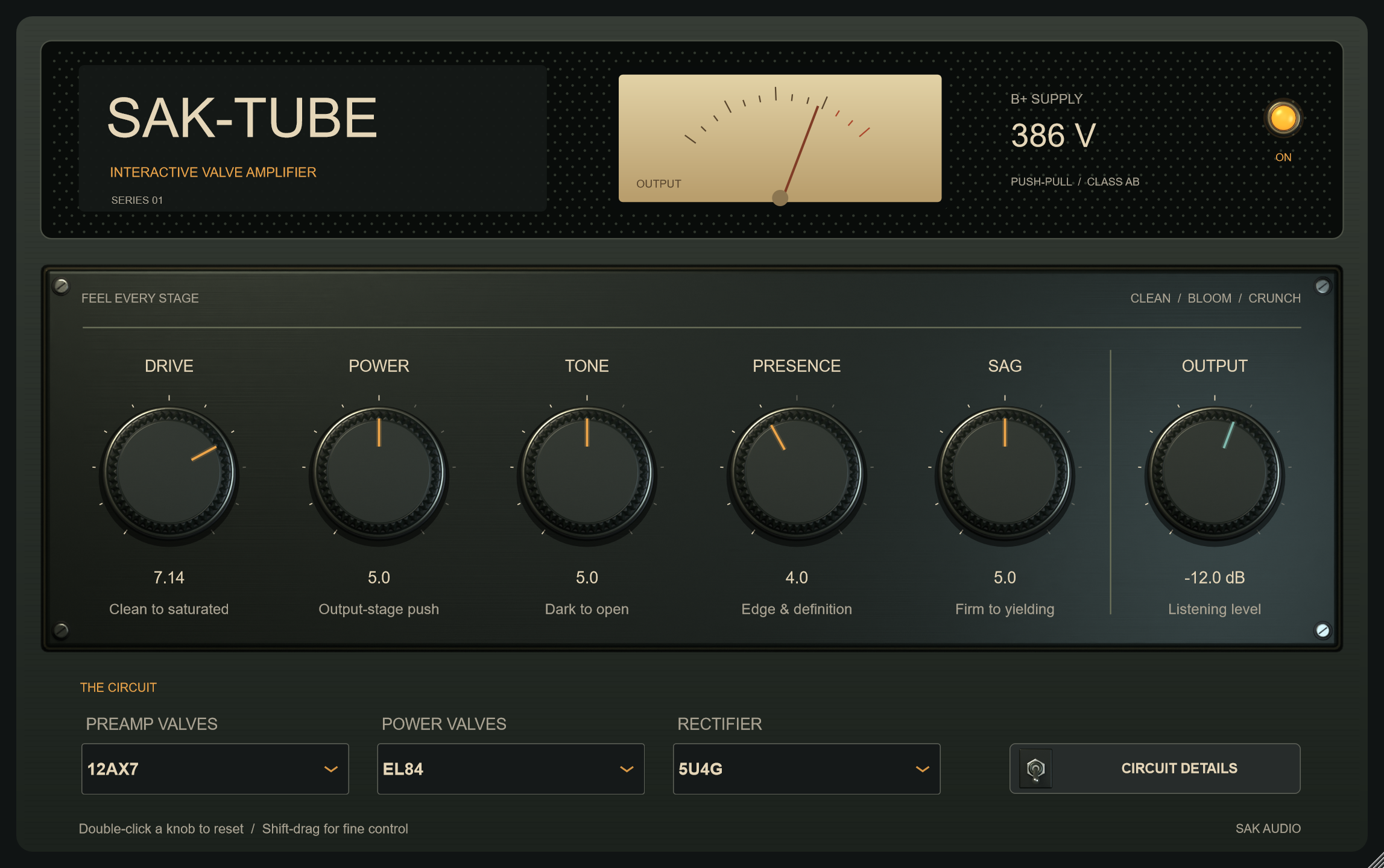
Bring the preamp from a light touch to compression and grit. Each valve family has its own gain range and surrounding circuit.
SAK-TUBE / VALVE AMPLIFIER
The weight of iron. The give of a power supply.
The way a valve responds when you lean in.
An interacting amplifier circuit, from the first triode to the speaker load. Made to be played. Free to download.
WINDOWS x64 · VST3 + STANDALONE · v0.1.3
AN AMPLIFIER, INSIDE THE BOX
Hit a chord and the circuit moves with it. Valves draw current. The supply gives ground. The transformer remembers. The next note arrives in a slightly different world.
SAK-TUBE connects those behaviours in one amplifier. Keep it subtle on a track, bring a bass forward, or push the output stage until the attack folds into a slow bloom.
Go inside the circuitLISTEN / SAK-TUBE
Hear where the character comes from. Move the work from the preamp to the power section, or lean into both.
A synthesized string study: soft and hard plucks, low-E bursts, a chord and a sustained note. Real circuit renders, fixed level adjustment per clip for comparison. No cabinet IR. The waveform above is illustrative.
02 / FIND YOUR BALANCE
Move the saturation around the circuit. Calibrated makeup keeps the listening level in a useful range while the dynamics stay alive.
Bring the preamp from a light touch to compression and grit. Each valve family has its own gain range and surrounding circuit.
Push the phase inverter, output valves and transformer. Hear the supply sag and the low end work against the magnetic core.
The final listening control, after the physical circuit. Trim for your mix and leave the amplifier’s internal interactions intact.
03 / UNDER THE FACEPLATE
Reference-fitted valve curves meet a reactive speaker load, shared supply and a hysteretic output transformer. The interaction is the instrument.
12AX7, 12AT7 or 12AU7 up front. EL34, 6L6GC, EL84 or KT88 at the output. Distinct tube laws and matched circuit configurations keep the differences meaningful.
The Jiles–Atherton output core carries magnetic history. Strong low notes increase magnetizing current, reduce incremental inductance and change how the output valves see the load.
Choose Silicon, GZ34 or 5U4G rectification. Shared supply rails, screen current, coupling charge and bias memory shape the space after the attack.
Controls, circuit values, equations, sources and the limits of the model.
YOUR NEXT SESSION
SAK-TUBE is free. No account. No activation.
Just an amplifier with a lot going on inside.
Corrected high-frequency response with lower circuit CPU cost. New instances start at 1x; saved sessions retain their quality. Updated 1x / 2x / 4x execution and 128-sample latency.
Windows x64 · VST3 + standalone
Download for Windows 30.9 MB · WINDOWS INSTALLERUnsigned release. Windows may show a publisher warning. File checksums.
A FEW PRACTICAL THINGS
A Windows x64 computer and a host that supports 64-bit VST3 effects. This release is tested on Windows 11. A standalone application is included as an optional install. macOS, Linux, AU and AAX builds are not included.
Yes. Download SAK-TUBE directly, with no account, activation key or subscription. It is open-source software under AGPLv3, and the matching source includes JUCE and build instructions. The installer and portable package contain the same amplifier. The software license does not apply to music you process with it.
It models the speaker’s electrical impedance, so the output stage feels a reactive load. It does not include an acoustic cabinet or microphone IR. Add your preferred cabinet IR after SAK-TUBE for a recorded guitar-cab sound; leave it off when treating other material.
New instances start at 1× for lower CPU use. Choose 2× or 4× for stronger alias rejection when your CPU allows, or use 4× for offline renders. Saved sessions retain their quality setting. Every mode reports 128 host samples of latency.
Run the installer with your audio host closed. It installs the complete VST3 bundle in the common VST3 folder, then you can rescan plugins in your host. Remove an installed copy through Windows Settings → Apps. For a manual install, unzip the portable download and copy the whole SAK-TUBE.vst3 folder into C:\Program Files\Common Files\VST3. See the manual for runtime and troubleshooting details.
Drive excites the preamp. Power excites the inverter and output section. Fixed, parameter-dependent makeup reduces their volume swings; Output sets the final listening level. The compensation is approximate and never follows the input envelope, so the circuit’s dynamics still come through.